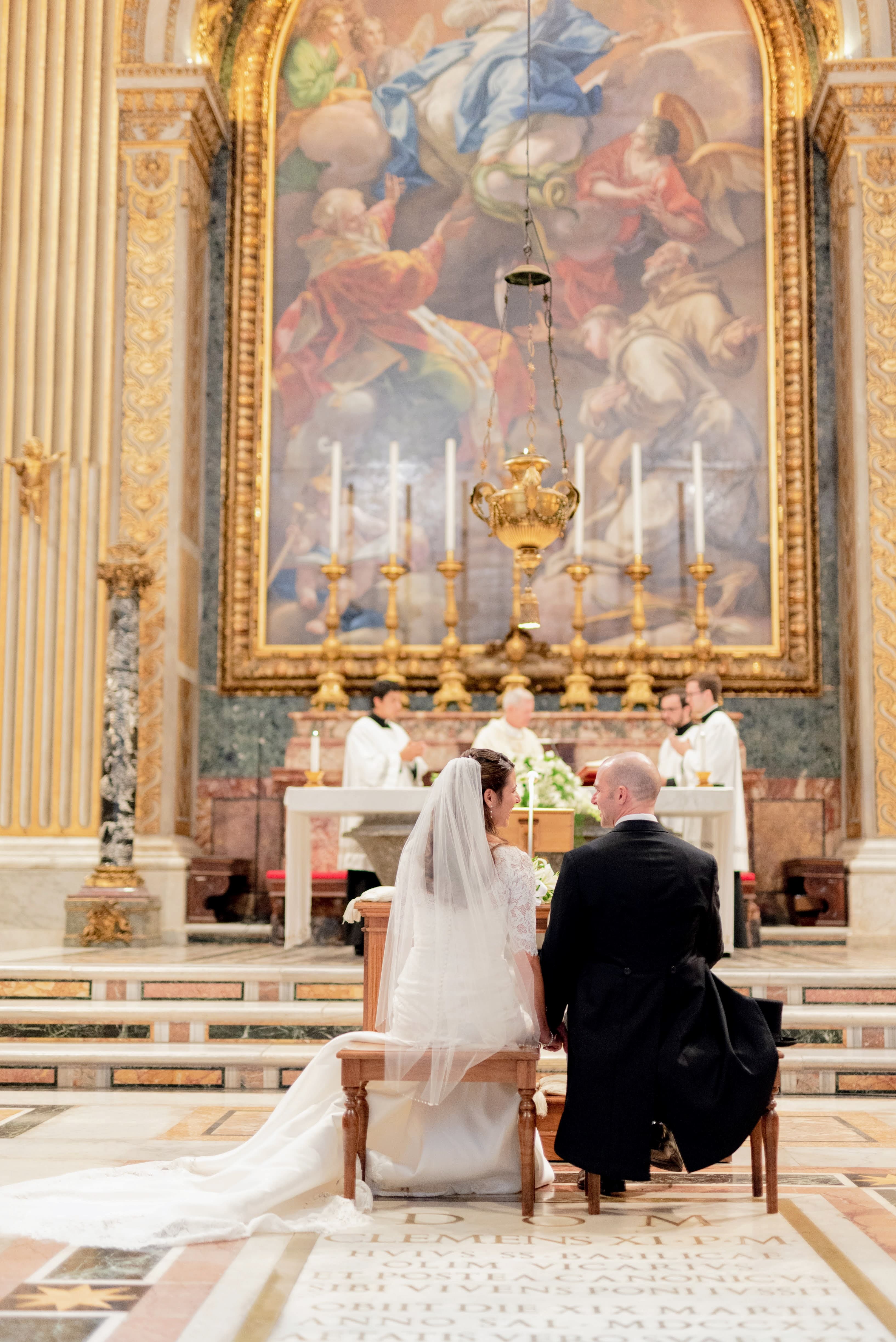
Bringing Your Marriage into the Church
Convalidation is the process by which a couple who married civilly, or outside the Church without proper permission, has their marriage recognized and blessed by the Catholic Church. It is a beautiful opportunity to celebrate your commitment in the full sacramental life of the Church.
What Is Convalidation?
Convalidation is more than a blessing. It is a new wedding ceremony where the couple exchanges consent before a priest or deacon and two witnesses. This creates a valid, sacramental marriage in the eyes of the Church.
Convalidation is the process by which a couple who married civilly, or outside the Church without proper permission, has their marriage recognized by the Catholic Church. It is a real wedding ceremony, not just a blessing.
The couple exchanges new consent before a priest or deacon and two witnesses. This is not simply a blessing of an existing marriage, but a new act of consent that creates a sacramental marriage.
If both parties are baptized Christians, convalidation makes the marriage a sacrament. If one or both parties are unbaptized, the marriage becomes valid in the eyes of the Church but not sacramental.
Colloquially, many people refer to convalidation as "having our marriage blessed by the Church." While this phrase is commonly used, the technical term is convalidation, and it involves a new exchange of consent.
When Convalidation Is Needed
Convalidation is necessary when a Catholic marries outside the Church without proper permission, or when a couple living together wishes to bring their relationship into full communion with the Church. Find your scenario below.
If a Catholic marries in a civil ceremony, courthouse, or non-Catholic church without obtaining a dispensation from canonical form, the marriage is not recognized by the Church. Convalidation brings the marriage into the Church.
A civil marriage performed by a judge, justice of the peace, or other government official is valid in civil law but not recognized as valid by the Catholic Church for baptized Catholics. Convalidation is needed.
If a Catholic marries in a Protestant, Orthodox, or other non-Catholic church without obtaining permission (called a dispensation from canonical form), the Church does not recognize the marriage. Convalidation rectifies this.
Couples who have been living together without a formal marriage, or who married civilly and now wish to become fully active in the Catholic Church, can have their relationship convalidated as part of their journey into the Church.
Convalidation vs. Radical Sanation
There are two ways the Church can recognize a marriage that was not initially valid. Understanding the difference helps clarify what the priest will recommend.
Requires a new ceremony where both parties exchange consent again before a priest or deacon and two witnesses. This is the most common path and is used when both parties are able and willing to consent again.
Key: New ceremony, new consent.
A bishop grants retroactive validity to a marriage without requiring a new ceremony. This is used in rare cases when one party cannot or will not consent again (e.g., incapacitated, deceased, or unwilling). The marriage is recognized as valid from the original date.
Key: No ceremony, granted retroactively.
The Convalidation Process
The process is similar to preparing for a first marriage, but typically shorter since you have already lived as a married couple. Here are the typical steps.
Schedule a meeting with your local parish priest. Explain your situation and your desire to have your marriage recognized by the Church. The priest will guide you through the specific requirements.
Most parishes require some form of marriage preparation, though it is typically shorter than the full preparation required for couples marrying for the first time. This may include a retreat, classes, or meetings with the priest.
You will need your civil marriage certificate, baptismal certificates for both parties (if baptized), and proof of freedom to marry. If either party was previously married, an annulment may be required before convalidation can proceed.
Decide on the type of ceremony you want. It can be as simple as a private exchange of vows with just the priest and two witnesses, or a full celebration with family, friends, Mass, readings, and music.
At the ceremony, you will exchange new consent before the priest or deacon and two witnesses. This can take place during a Nuptial Mass or outside of Mass. The ceremony includes the exchange of consent and the blessing of the marriage.
What the Ceremony Looks Like
Convalidation ceremonies can range from very simple to fully elaborate. The couple chooses what feels right for them. Here are common options.
A simple exchange of consent with the priest or deacon and two witnesses. No guests, no Mass, just the essential elements. This is the minimum requirement and is often chosen by couples who prefer simplicity.
A ceremony with close family and friends present. May include readings, music, and the exchange of rings. The ceremony takes place outside of Mass but includes many traditional wedding elements.
A complete wedding Mass with all the traditional elements: readings, homily, exchange of consent, blessing and exchange of rings, nuptial blessing, and Eucharist. This is the fullest expression of a Catholic wedding.
Many couples choose to convalidate on their civil wedding anniversary, a meaningful feast day, or another significant date. This adds personal meaning to the celebration of bringing the marriage into the Church.
Frequently Asked Questions
These are the most common questions couples ask when exploring convalidation.
It varies by parish and your specific situation. If all documents are in order and no prior marriages need to be addressed, the process can take as little as a few weeks. If an annulment is required, it may take several months or longer.
No. Most parishes offer an abbreviated form of marriage preparation for couples seeking convalidation. You have already lived as a married couple, so the preparation focuses on the sacramental nature of marriage and your commitment to living it in the Church.
Absolutely. Many couples include their children as part of the celebration, whether as witnesses, readers, or simply present to witness their parents having their marriage blessed. This can be a beautiful family moment.
If one or both of you are Catholic and married outside the Church without a dispensation, the Church does not recognize the marriage as valid. However, it is valid in civil law. Convalidation brings the marriage into full recognition by the Church.
Convalidation is still possible. The non-Catholic partner does not need to become Catholic. The marriage will be recognized by the Church, and if both are baptized (even in different denominations), it will be a sacramental marriage.
It depends. If either party was previously married, that prior marriage must be addressed (through annulment or other means) before convalidation can happen. Your parish priest will help you navigate this. If there are no prior marriages, convalidation can often proceed quickly.
This page provides general guidance. Your local parish and diocese will have specific requirements and timelines. Contact your parish priest to begin the convalidation process. Most priests are familiar with this process and will guide you warmly through each step.