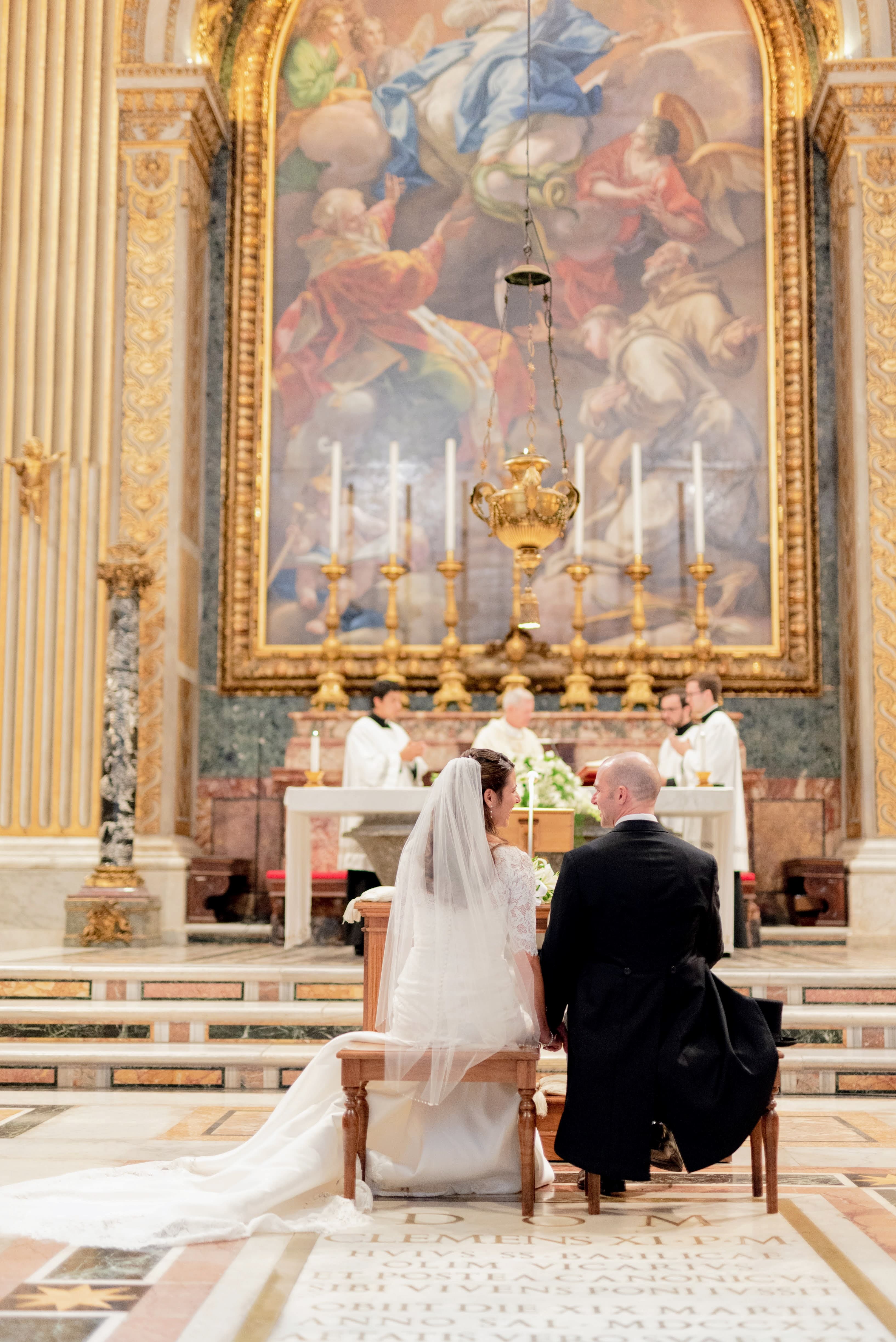
Catholic Wedding Vows
The words you speak at the altar are not a personal expression: they are the sacramental form of the marriage rite. This guide covers every approved formula, what each phrase means theologically, and why the Church requires specific words.
The Consent Questions
Before the vows, the priest asks each spouse three questions. These are not the vows themselves: they establish that the couple is entering marriage freely and with the right intentions.
Establishes that the marriage is freely chosen: not forced, arranged under duress, or entered under false pretenses.
Affirms permanence. The couple must intend a lifelong, exclusive bond: not a conditional commitment.
Affirms openness to life: a defining mark of sacramental marriage. Couples must be open to children; deliberately excluding them invalidates the marriage.
Form A (Most Common)
The traditional formula, used in the United States and most English-speaking countries. It is the form most couples recognize from films and family weddings.
I, [Name], take you, [Name], for my lawful wife, to have and to hold, from this day forward, for better, for worse, for richer, for poorer, in sickness and in health, until death do us part.
I, [Name], take you, [Name], for my lawful husband, to have and to hold, from this day forward, for better, for worse, for richer, for poorer, in sickness and in health, until death do us part.
Form B
A shorter, equally valid formula approved by the USCCB. Some couples prefer its more direct language. The meaning is identical to Form A.
I, [Name], take you, [Name], as my wife. I promise to be faithful to you, in good times and in bad, in sickness and in health, to love you and to honor you all the days of my life.
I, [Name], take you, [Name], as my husband. I promise to be faithful to you, in good times and in bad, in sickness and in health, to love you and to honor you all the days of my life.
The Ring Exchange
Each spouse speaks these words while placing the ring on the other's finger. The ring blessing precedes this exchange and is prayed by the priest.
[Name], receive this ring as a sign of my love and fidelity. In the name of the Father, and of the Son, and of the Holy Spirit.
Understanding the Vows
Each phrase of the vow formula carries a specific theological meaning. These are not poetic flourishes: they define the essential properties of the sacrament.
The couple accepts the full range of human circumstances. Marriage is not conditional on happiness. This phrase rules out "irreconcilable differences" as grounds for abandoning the vow.
Financial circumstances do not dissolve the bond. The Church recognizes that economic stress is one of the most common strains on marriage: this phrase names it explicitly and refuses it as an exit.
The vow extends to physical and mental suffering. This is not poetic: it is a promise to care for a spouse who may become profoundly dependent. It directly reflects Christ's self-giving love.
Permanence is non-negotiable in Catholic marriage. A valid sacramental marriage cannot be dissolved while both spouses live. This is what distinguishes sacramental marriage from a civil contract.
The language of possession and belonging: but mutual. Each gives themselves fully and receives the other fully. This is the essence of the total self-donation that defines sacramental love.
The vow formula is not a personal expression: it is the sacramental form of the marriage rite. In Catholic theology, the couple are the ministers of the sacrament, and their consent is the matter and form. The Church has specified the exact words because they must contain the essential properties of marriage: unity, exclusivity, permanence, and openness to life. Custom vows, however heartfelt, may omit these properties and thus fail to constitute valid consent. Your priest cannot accept them.
The consent questions asked by the priest are not the vows: they are a preparatory declaration of intent. The vow itself is the formula spoken by the spouses directly to each other. Canon Law (c. 1057) defines marriage as "brought into being by the lawfully manifested consent of persons who are legally capable." The consent questions confirm eligibility and intent; the vow formula is the actual act of consent.
Common Questions
Answers to the questions couples ask most about Catholic wedding vows.
No. The Catholic Church requires one of the approved vow formulas (Form A or Form B). The vow is a sacramental form, not a personal expression. You may write personal letters to each other to read privately or at the rehearsal dinner, but the ceremony itself requires the approved words.
Form A is the traditional formula ("to have and to hold... until death do us part"). Form B is shorter and uses slightly different phrasing ("I promise to be faithful to you..."). Both are theologically equivalent and fully valid. Choose based on which language resonates more with you as a couple.
Yes, absolutely. Most priests offer the option to repeat phrase-by-phrase or to recite from memory. If you want to memorize, tell your priest during the preparation meetings so he can accommodate that in the rehearsal. Many couples find memorizing deeply meaningful.
This is extremely common. Your priest will go slowly and prompt you word by word if needed. The ceremony will not be invalidated by tears or pauses: the Church expects human emotion at this moment. Practice out loud many times before the wedding so the words come more easily under pressure.
No. The three consent questions asked by the priest at the beginning of the Rite of Marriage confirm your freedom, permanence, and openness to children. The vows (spoken to each other) are the actual act of consent that brings the marriage into being. Both are required; they serve different but complementary roles.
Possibly, but with permission. Unity ceremonies are not part of the Rite of Marriage and are not universally permitted. Some dioceses and parishes allow them; others do not. Ask your priest early. If permitted, the unity ceremony typically takes place immediately after the exchange of rings, not during the vows themselves.
The vow formulas on this page reflect the current Rite of Marriage as approved in the United States. Confirm the exact wording with your priest during preparation, as local adaptations may vary slightly.