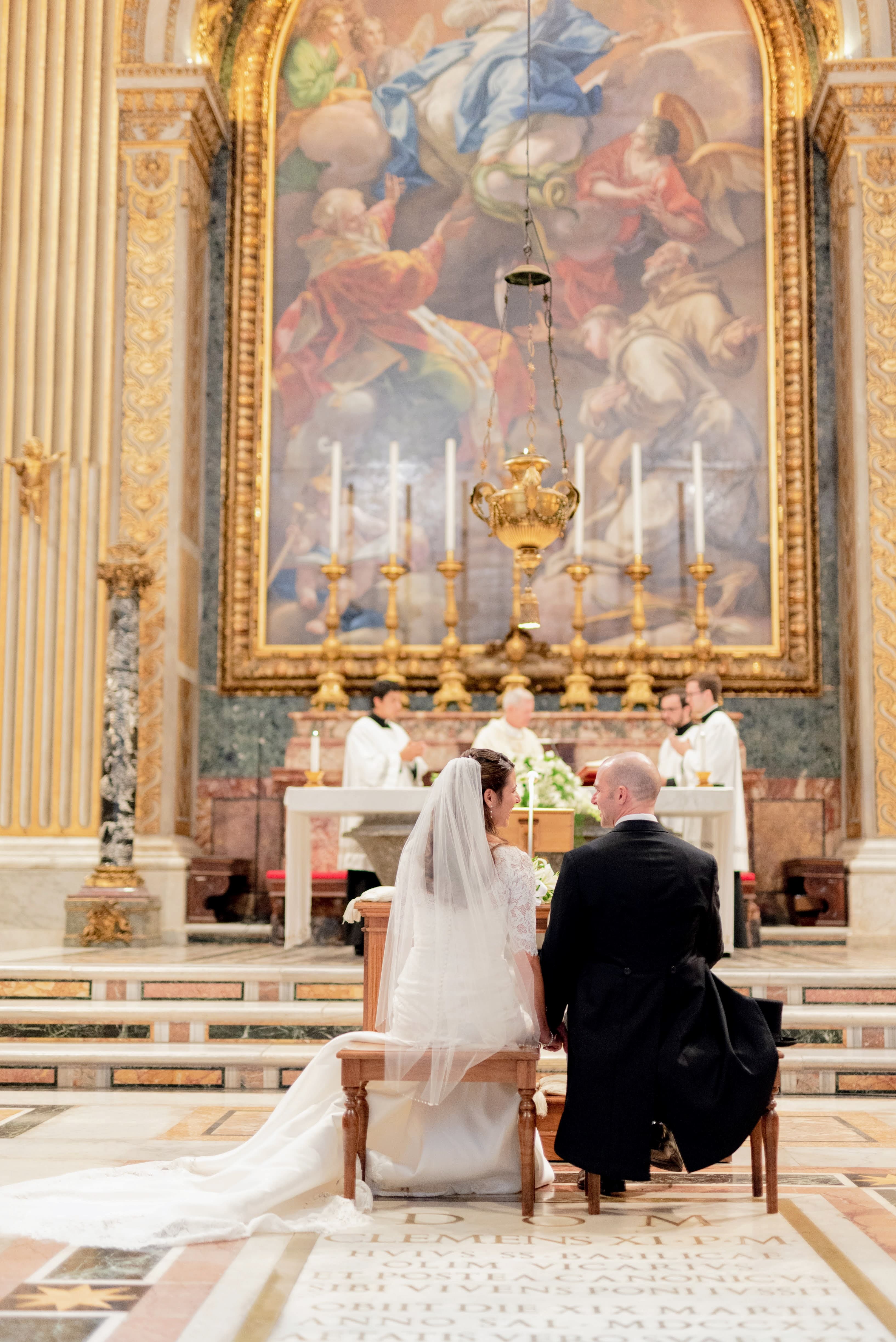
The Catholic Wedding Mass
A Catholic wedding can be celebrated as a Nuptial Mass or as a Rite of Marriage outside Mass. This guide explains both forms step-by-step, how long each takes, who can receive communion, and how to choose the right form for your situation.
What Is a Nuptial Mass?
A Nuptial Mass is a Catholic wedding celebrated within the full Liturgy of the Eucharist. It is the richest form of the wedding rite and is the norm when both partners are Catholic. The ceremony follows the same structure as Sunday Mass (Liturgy of the Word, then Liturgy of the Eucharist) with the Rite of Marriage inserted after the homily.
Full Liturgy of the Word + Rite of Marriage + Liturgy of the Eucharist. Both partners can receive communion together. Lasts approximately 45-60 minutes.
Liturgy of the Word + Rite of Marriage. No Eucharist is celebrated. Typical when one partner is not Catholic. Lasts approximately 20-30 minutes.
Order of the Nuptial Mass
The ten parts of the Nuptial Mass in the order they occur during the celebration.
The wedding party processes into the church while the entrance hymn is sung. The order varies by parish custom: the groom may be already at the altar or may process with his groomsmen.
The priest greets the assembly, acknowledging the sacrament being celebrated. The opening prayer (Collect) gathers the intentions of the community.
Three readings are proclaimed: an Old Testament reading, a Responsorial Psalm (sung), and a New Testament reading. The Gospel is then proclaimed by the deacon or priest. Couples choose from the approved set of wedding readings.
The priest or deacon breaks open the Word of God, relating the readings to marriage and the specific couple. This is a required element of the Nuptial Mass: it is never omitted.
The heart of the ceremony. The priest questions the couple on their freedom and fidelity. The couple exchanges vows: the actual sacramental moment. Rings are blessed and exchanged. The Nuptial Blessing may be given here or after the Our Father.
Intercessory prayers are offered for the couple, the Church, the world, and those in need. These are often composed with the couple's family in mind and may be read by family members.
Gifts of bread and wine are brought to the altar (Offertory). The Eucharistic Prayer consecrates them into the Body and Blood of Christ. The Our Father is prayed and the Sign of Peace exchanged.
Baptized Catholics in a state of grace receive the Eucharist. The couple typically receives first. Non-Catholic guests remain seated and do not come forward for communion.
The priest gives the solemn nuptial blessing over the couple. The assembly is then dismissed with a blessing and sent forth to proclaim the Gospel by their lives.
The newly married couple leads the procession out of the church while joyful music is played. This is the most musically flexible moment of the entire celebration.
Order of the Ceremony Without Mass
The Rite of Marriage outside Mass follows the same essential structure but concludes before the Liturgy of the Eucharist.
The wedding party processes into the church while music is played or sung. Same as the Nuptial Mass entrance.
The priest or deacon greets the assembly and offers the opening prayer, acknowledging the sacrament of marriage.
One or two readings from Scripture are proclaimed, followed by the Responsorial Psalm (sung) and the Gospel. The same approved set of wedding readings applies.
The priest or deacon preaches on the readings and the meaning of marriage. Required in the ceremony without Mass as well.
The priest questions the couple, they exchange vows, and rings are blessed and exchanged. This is the same essential sacramental rite as in the Nuptial Mass.
Intercessory prayers for the couple, Church, and world. Family members may lead the petitions.
The solemn nuptial blessing is given over the couple. In the ceremony without Mass, this occurs here rather than after the Our Father.
The priest blesses the assembly and sends them forth. The ceremony concludes without the Liturgy of the Eucharist.
The couple leads the procession out to joyful music. The overall experience is shorter but no less sacred.
Which Form Should You Choose?
The right form depends on your situation. Your priest will guide you through this decision during marriage preparation.
A Nuptial Mass is the norm. The Church strongly encourages it because both spouses can fully participate in the Eucharist together.
A ceremony without Mass is usually recommended. Having a Mass when many guests cannot receive communion can create an awkward moment. Many parishes and priests will suggest this option for pastoral reasons.
A ceremony without Mass is required. Church law requires a dispensation from disparity of cult for this marriage (canon 1086), and the rite is celebrated outside Mass.
A ceremony without Mass is approximately 20-30 minutes vs. 45-60 minutes for a Nuptial Mass. If elderly guests, small children, or cultural factors make a shorter ceremony preferable, discuss this with your priest.
Duration
45-60 minutes
Longer homilies, music preludes, or large communion distribution can extend this. Couples with many non-Catholic guests sometimes choose the ceremony without Mass for this reason.
20-30 minutes
A more streamlined celebration that is still fully sacramental. Ideal when the guest list includes many non-Catholic family members or when a shorter ceremony is pastorally appropriate.
Communion at a Catholic Wedding
The Eucharist is the source and summit of Catholic life: which is why communion at a wedding requires care and communication.
Only baptized Catholics who are in a state of grace (no unconfessed serious sin) and have observed a one-hour fast from food and drink (water and medicine are exempt). Eastern Catholics in full communion with Rome may also receive.
Non-Catholic Christians, non-Christians, Catholics who are not in a state of grace, and Catholics who have not observed the fast. Guests in these situations are warmly welcomed to remain seated and are encouraged to make a spiritual communion in their hearts.
Include a note in your wedding program explaining who may receive communion and inviting non-communicants to offer a prayer of blessing. Your priest can provide suggested wording. This practice is charitable, not exclusionary: it helps guests feel included even when they do not come forward.
Common Questions
Answers to the questions couples ask most about the Catholic wedding Mass.
A Nuptial Mass typically lasts 45-60 minutes. A ceremony without Mass runs 20-30 minutes. These estimates assume an average-sized parish and no unusual delays. Larger choirs, longer homilies, or musical preludes can add time.
No. Only baptized Catholics who are in a state of grace and have observed the required Eucharistic fast may receive communion. Non-Catholic guests are warmly welcomed to the ceremony but should remain seated during communion. It is customary to include a note in the wedding program explaining this charitably.
No. The Church offers two valid forms of the wedding rite: the Nuptial Mass and the Rite of Marriage Outside Mass. Both are fully sacramental Catholic weddings. Your priest can help you discern which form is most appropriate for your situation.
Yes, Saturday evening weddings are common. If a Nuptial Mass is celebrated after 4:00 PM on Saturday, it fulfills the Sunday Mass obligation for those present. Check with your parish for their specific Saturday evening availability.
A Catholic can marry a baptized non-Catholic (mixed marriage) or a non-baptized person (disparity of cult) with proper permissions from the bishop. In both cases, the ceremony without Mass is usually recommended or required. The marriage is still fully valid and sacramental (when both are baptized).
Normally, no. Canon law requires Catholic marriages to be celebrated in a church or oratory. Exceptions can be granted by the diocesan bishop for serious reasons (e.g., a marriage between a Catholic and a non-Catholic in the non-Catholic's place of worship). Outdoor weddings are not generally approved in most dioceses.
Each diocese and parish may have specific guidelines beyond universal Church law. Confirm the details of your wedding ceremony (including the form, minister, and communion logistics) with your parish priest during marriage preparation.